

#36: Sour Oranges (Language Notes)
soy milk with every meal in rainy Taipei

I had never been underground during an earthquake before. We couldn’t feel anything, only the gentle motion of the train, but an announcement rang out first in Chinese, then English: There have been earth tremors. Trains will travel at a reduced speed until the alarm is lifted. Mum said she’d caught the word 地震 dìzhēn, earthquake, from the loudspeakers when we’d been on the platform, but she hadn’t heard the rest of the sentence. Nothing seemed out of the ordinary; the tremors must have been located far from the centre of Taipei. The train carried us safely under the surface of the earth. We rode the escalator through the slow-moving rush hour crowd, emerging out into the warm rain.
Taipei felt slower to me than Shanghai. The low-rise city is smaller, in a basin surrounded by vivid green hills that seem within touching distance. On the metro, instead of tapping your debit card, visitors exchange coins for plastic blue tokens.
~
My first meal in Taipei was a bowl of beef noodle soup. I rarely ate beef these days and felt unsure about ordering it—even here, where the dish is famous. But it was the only item I could read on the menu. The traditional character for noodle, 麵, was one of few I could recognise thanks to the right-hand side 面 that has been retained in simplified Chinese. Minutes later, I was served a wide bowl of soup with steel chopsticks and a cold cup of soy milk. I’ve had many bowls of beef noodle soup in my life but nothing like this one, with chunky noodles and a deep, richly-seasoned broth scattered with preserved vegetables. My mum was resting back at our hotel so I made a note of the location, marking it with a pin on the map.
~
We were both struggling to keep up with the Taiwanese Mandarin we heard all around us, far more rapid than the long vowel sounds of Beijing Mandarin, the variation of the language that is taught in textbooks all over the globe. In Taipei, my mother was doing far better than me—though sometimes entire phrases caught us off guard, and the person we were speaking to had to try to find another way to explain themselves.
~
In Shanghai, a week earlier, I’d started to get a grip again on reading menus and signs around the city. Some of the characters were coming back to me. But here in Taipei, the script was mostly a tangle of strokes, a dense thicket. I’d often look up the traditional and simplified characters to try to compare them side by side. Sometimes it would take me a second to see clearly what had been lost.
My grandparents would have been able to read both.
麵 面
灣 湾
雲 云
漿 浆
~
Back in London, I sign up for an online writing class. We are talking about linearity, and how we can apply different kinds of structures in our nonfiction writing. Clouds, circles, waves, parallel lines. I draw a river with many bends.
I thought of how my many Chinese teachers over the years had (both explicitly and implicitly) painted a picture of the language as if it were a tree, with standardised Mandarin at the base, and all the hundreds (maybe thousands) of variants and dialects sprouting off from it in branches. This is how it can appear, from the centre.
~
If Taipei felt familiar, that was because I’d seen parts of it before through friends’ eyes, in their writing and their Instagram posts. Now, I was moving through the city guided by a map on my phone dotted with places sent to me by those same friends. A favourite bookshop, an egg waffle café, the best 24-hour soy milk shop. And my mum had told me of visits to Taiwan with her siblings and parents when she was a child. My grandfather had gone to university in the Chinese coastal city of Xiamen, not far from Taiwan, and several of his classmates had later relocated to Taipei.
Mum and I went to the fabric market near Dihua Street. It was a sweltering morning. Inside the market, she took pictures of me surrounded by piles bolts of cotton and linen. Afterwards we passed a narrow temple wedged between buildings, up to five storeys high, multiple shrines stacked on top of each other. Taipei was full of these compact spaces of urban worship. I was drawn to them, even though I had no religious connection to them. They reminded me of Hong Kong, another beloved city.
We walked up the street past vendors selling tea and souvenirs. I checked the map, as I had been doing all morning. At the top of the street, there was a waffle shop my friend J had told me about: Yuciren Happy Waffle. The woman at the counter somehow understood me perfectly. Dark chocolate tea waffle, iced lemon tea. Mum wanted ice cream, so I got her the soft serve special of the day: salted milk. The ice cream arrived swirled impossibly high, a creamy peak unmelting under the cold air-con.
~
The slide on the screen said, “Declare a new place of origin, one not found on any map,” (Susan Briante).
Can a language be a place of origin? What is a place of origin? What is a language?
Whether in London or Taipei or Shanghai, when I’m walking through dark and quiet streets, I am always glancing down at the digital map to find my way. Wellington might be the only place where I don’t need a map.
~
In the evening we met up with a friend from Wellington who took us to his favourite Hakka restaurant in Taipei. Jinjiang Teahouse was a ramshackle cottage nestled among tall office buildings, an anomaly in the shiny cityscape. The windows glowed with warm light and bougainvillea crawled across the tiled roof. The Chinese-only menu was printed on a pink slip of paper. A familiar thought surfaced: if I spent as many hours studying Chinese as I did learning to knit, would I be able to read the menu? My friend ordered for the table. I told him I often dreamed of méicài kòuròu, Hakka steamed pork with preserved mustard greens. He made a mark on the piece of paper next to four characters I actually could read: 梅菜扣肉. The dishes arrived one by one: poached chicken with kumquat sauce, fresh rice noodles, steamed tofu, stir-fried mountain fern, and the soft slices of steamed pork laid atop a bed of dark leaves.
~
There was an incredible rainstorm, so we decided to stay in. I ordered from a nearby 24-hour breakfast shop and went to meet the delivery driver on the street, the rain coming down around us in waves like something from a movie. I carried the still-hot cardboard cups of soy milk up to our room. We’ve always excelled at hotel room picnics. Mum laid out napkins on the coffee table along with teaspoons, fruit and snacks we’d accumulated that day. I opened the cartons containing yóutiáo and two kinds of egg pancake, warm steam erupting into the room.
~
In her pamphlet Translation is a Mode=Translation is an Anti-neocolonial Mode, the poet Don Mee Choi writes: “Japanese was my father’s colonial language because he grew up during the occupation, and English is my neocolonial language because I grew up in South Korea, which I refer to as a neocolony of the US—politically, militarily and economically.”
For the neocolonizer, it would be convenient for a language to be fixed, unchanging. In reality, it flows. It grows into a forest. The borders of one bleed into another.
As for mine, I have at least two. Three, if you count one that has sunk to the bottom. They drip and melt like ice sheets.
~
I travel all over London with a new green tote bag I got in Taipei. It’s made from sturdy cotton, printed with line drawings of Taiwanese street snacks and the characters underneath. At a poetry event, a stranger points to my bag and says, “粽!” She says that she is half-Chinese, and being reminded of zòng (joong) brings her joy. On the way home I spot another girl on the Overground looking at my bag. Our eyes meet for a brief second. Next to her, there’s a smartly dressed middle-aged white man with lots of tattoos on his wrists, arms, neck. I notice letters inked on his hands. I realise they make up the word SKINHEAD, one letter on each knuckle.
~
Over dinner in Taipei, my friend told me that there are some characters that don’t have exact matches. According to an article in Sixth Tone, this is because “the simplification process merged two or more distinct characters into one.” They disrupt the field, and cannot be translated cleanly.
I am in the middle of a big project and the threads keep getting tangled. I lay them out here. I keep going back over them. For example, I’ve written before about how the German naturalist Engelbert Kaempfer misspelled the Japanese word “ginkyo”, giving us the English name “ginkgo”. How his misspelling was then taken up by Carl Linneus in Mantissa Plantarum II (1771).
~
I have 8 tattoos but none of them are words. I toyed with the idea of getting a Chinese character but never did, worried that this would be too white of me.
For several days afterwards, I have trouble getting over my shock that there are people who confidently travel on London public transport with the word sk*nhead exposed for all to see. When I tell a white friend what I saw and they respond “what does that mean?”, I am doubly shocked. Some things do not easily translate. I think of whiteness as an (in)visible force field. I think of how much has changed in the 8 years since I moved to the UK, hidden fault lines becoming plainly visible.
~
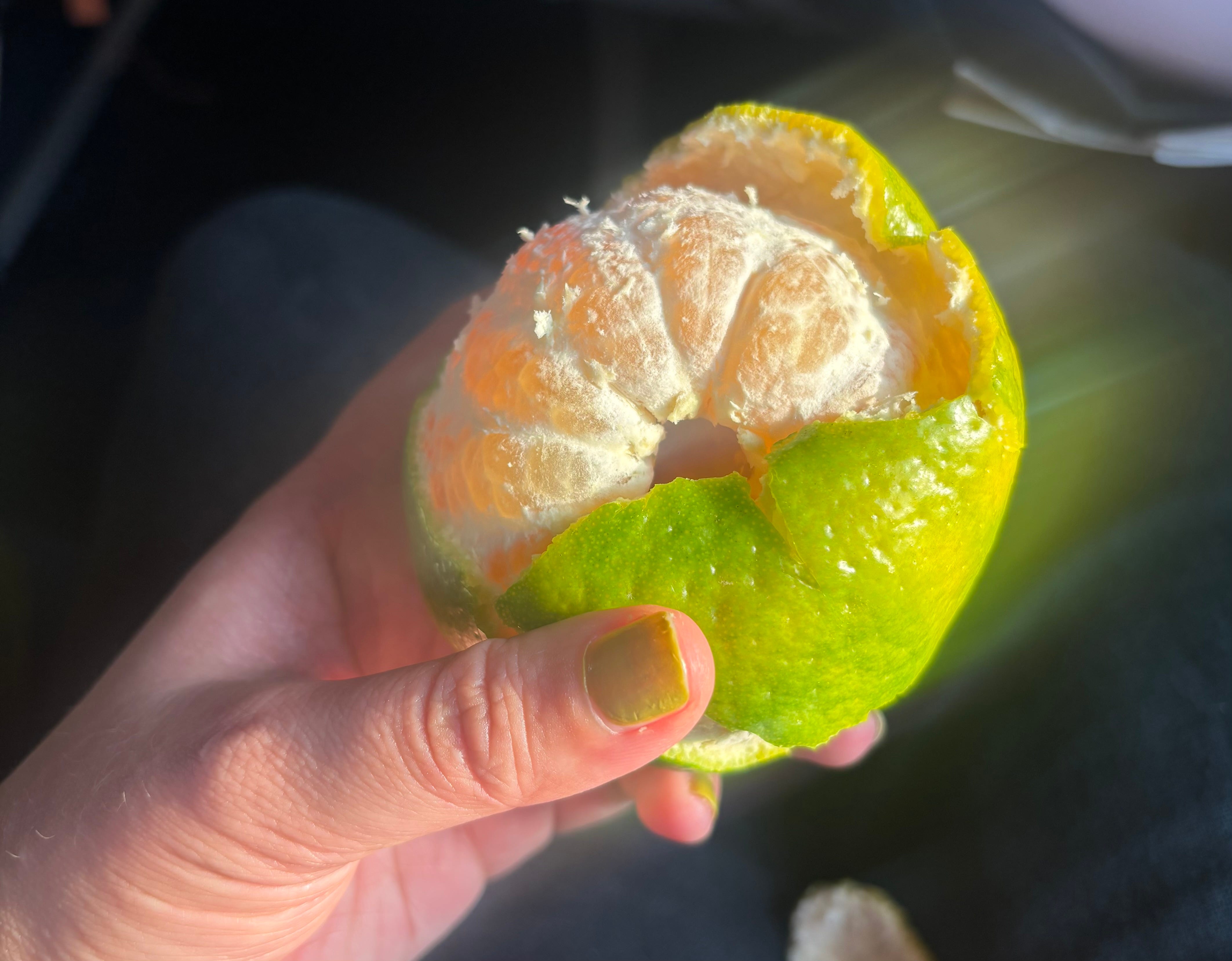
The fruit shops were all full of plump green Taiwanese oranges. I drew the characters into my dictionary app to find out how to pronounce their name. 椪柑, pèng gān. A thick-skinned hybrid cross between a pomelo and a mandarin, also known as: Chinese honey orange / green tangerine / green ponkan / citrus poonensis. I bought six, but my mum said they were too sour so I ate the rest myself. I had the last green honey orange on the plane heading westwards back towards Europe, full with the weight of leaving.
~
Declare a place of origin not found on any map. A bowl of macaroni, a box of threads, a hotel room picnic. A pattern of sour oranges. A language that changes shape. Hot soy milk with every meal.
~
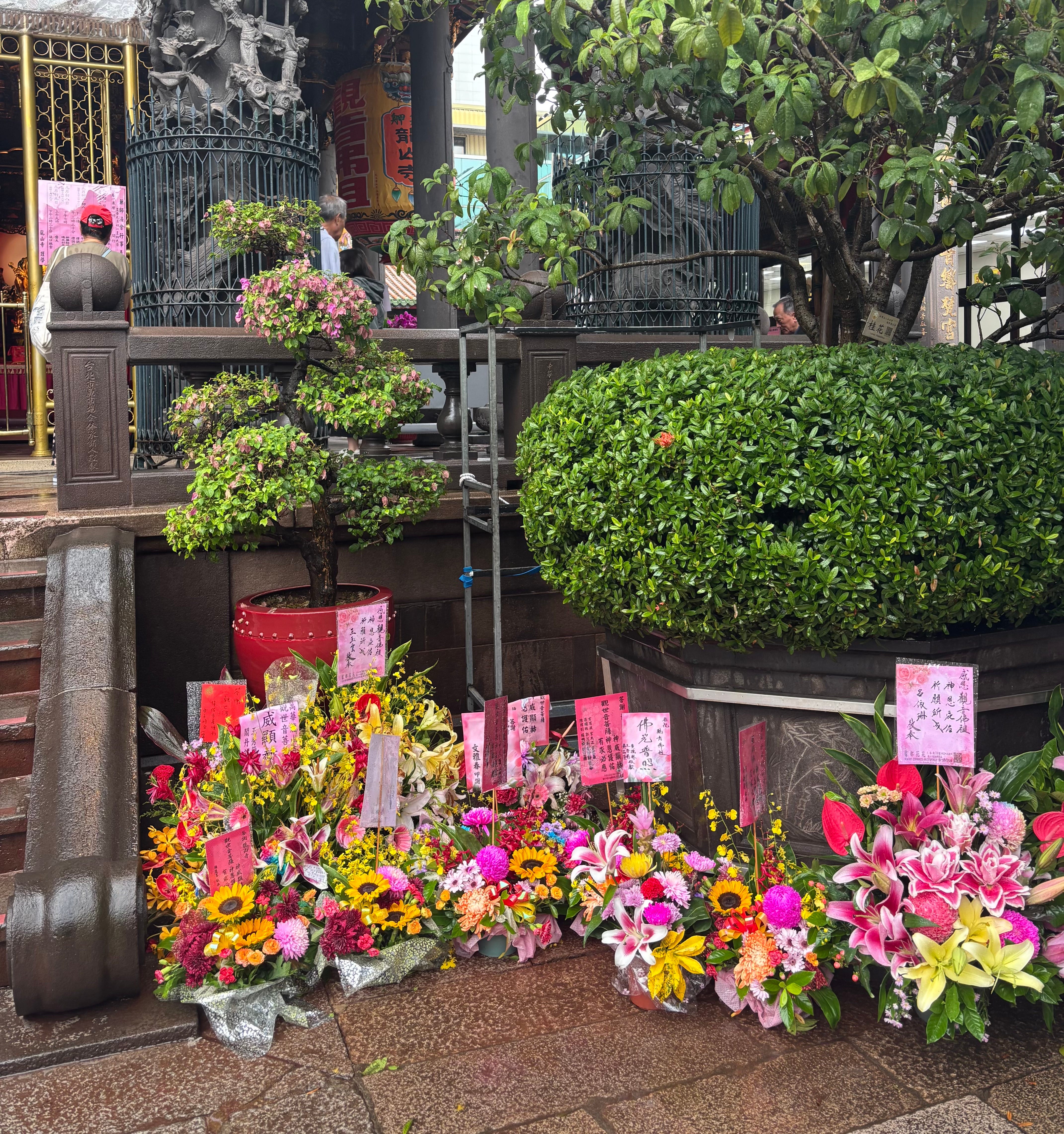
In Taipei, in front of a city temple, children’s drawings and 字 have been scribbled on coloured paper lanterns swaying in the wind.
In Hong Kong, domestic workers lay yellow flowers on a rain-soaked street.
In London, we meet at the Taiwanese noodle shop. The last leaves of the ginkgo are starting to fall.
This made me long for Taipei and London both. Thank you friend! 🍊
Oh how I am craving a Taiwanese soy milk now. Beautiful writing as always Nina